

NEWS & EVENTS
WHAT’S THE LATEST

Unlocking Financial Freedom: Why Variable Annuities Are Attractive
When it comes to securing one's financial future, many investment options are available. Among these, variable annuities have gained attention for their distinctive features and the attractive benefits they offer to investors.
Why do many consider variable annuities an appealing choice?
1. Tax-Deferred Growth
One of the primary attractions is their tax-deferral feature. When you invest in a variable annuity, your earnings are not taxed until you withdraw them. This allows your investment to grow faster over time, as you are not continuously eroding your returns through annual taxation. Tax-deferred growth can be particularly advantageous for long-term investors who plan to hold their annuities for many years.
2. Investment Variety in Variable Annuities
Variable annuities offer a diverse range of investment options. Unlike traditional fixed annuities, which provide a guaranteed interest rate, variable annuities allow you to invest in a mix of sub-accounts, which function similarly to mutual funds. This flexibility means you can tailor your investments to align with your risk tolerance, financial goals, and market expectations. It's an attractive choice for those seeking growth potential and investment control.
3. Market Potential
For investors willing to embrace market fluctuations, variable annuities can provide the opportunity for significant market-driven returns. The performance of your investments is tied to the performance of the underlying sub-accounts. While this comes with risk, it also offers the potential for higher returns than traditional fixed investments.
4. Guaranteed Income Options
Many variable annuities include optional riders, such as Guaranteed Minimum Income Benefits (GMIB) or Guaranteed Minimum Withdrawal Benefits (GMWB). These riders provide a safety net, guaranteeing a minimum income level during retirement, regardless of how your investments perform. This feature can be immensely attractive to retirees concerned about outliving their savings.
5. Estate Planning and Beneficiary Features
Variable annuities often offer favorable estate planning options. Upon the annuitant's passing, the remaining value of the annuity can be passed on to beneficiaries, typically without going through probate. This can simplify the inheritance process and provide heirs with a tax-efficient way to receive assets.
6. Annuity Payout Options
When you're ready to start receiving income from your variable annuity, you can choose how to receive payments. Options include a fixed period, amount, or lifetime income stream. This adaptability can align with your retirement income needs and preferences.
7. Creditor Protection
In some states, variable annuities may offer protection from creditors, which can be a valuable safeguard for your assets in case of unforeseen financial difficulties.
8. Professional Management
Experienced investment professionals, like Michael D. Peroo, CPA, typically manage variable annuities. This expertise can help investors navigate complex financial markets and make informed investment decisions.
Variable annuities can be an attractive addition to a well-rounded financial strategy, offering a unique blend of tax advantages, investment flexibility, and potential for market-driven growth. However, it's important to note that variable annuities are not suitable for everyone. They come with fees, risks, and complexities that require careful consideration.
Before investing in a variable annuity, it's crucial to thoroughly understand the terms and features of the specific product, assess your financial goals and risk tolerance, and consult a qualified financial advisor. When used appropriately and aligned with your financial objectives, variable annuities can be a powerful tool to help secure your financial future and achieve your long-term goals.

Tax Planning & Consulting
Unlocking the Power of Wealth Preservation: A Guide to Deferred Sales Trust
When selling appreciated assets like real estate, businesses, or valuable investments, one significant concern often arises: the hefty capital gains taxes that come with it. However, savvy investors and business owners have used a strategic financial tool for years to navigate this challenge – the Deferred Sales Trust (DST). This article will explore what a DST is, how it works, and why it has become an invaluable asset for those seeking to preserve their wealth and minimize tax liabilities.
What is a Deferred Sales Trust (DST)?
A DST is a legal and IRS-compliant financial strategy that allows individuals to defer capital gains taxes on the sale of highly appreciated assets. This innovative tool offers sellers an alternative to traditional sales transactions, such as direct sales or 1031 exchanges, which often trigger substantial tax obligations.
How Does a Deferred Sales Trust Work?
1. Asset Sale: The process begins with the seller agreeing with a third-party trust facilitator. When the seller finds a buyer for their asset, the sale proceeds are directed into the trust rather than directly to the seller.
2. Tax Deferral: Using a Deferred Sales Trust, the seller can defer the capital gains tax they would have owed upon the sale. This tax liability is deferred until the seller chooses to receive payments from the trust.
3. Investment Opportunities: Inside the trust, the funds can be invested in a diverse range of assets, such as stocks, bonds, real estate, or other income-generating investments. This allows the principal to grow over time.
4. Periodic Payments: The seller can structure the trust to make periodic payments to themselves, creating a reliable income stream. These payments can be customized based on the seller's financial goals and needs.
Key Benefits of a Deferred Sales Trust
1. Tax Deferral: The primary advantage of a DST is the ability to defer capital gains taxes. Sellers can enjoy the benefits of their sale without immediately facing substantial tax bills.
2. Wealth Preservation: DSTs provide a means to preserve wealth and grow assets within the trust, potentially generating additional income over time.
3. Flexibility: Sellers can determine when and how much income to receive from the trust. This flexibility can be particularly valuable for retirement planning or estate preservation.
4. Diversification: DSTs allow for diversification of investments, reducing risk and potentially increasing returns.
5. Estate Planning: DSTs can be incorporated into estate planning strategies, enabling the efficient transfer of assets to heirs.
Is a Deferred Sales Trust Right for You?
While Deferred Sales Trusts offer substantial benefits, they may not suit every situation. Consider the following factors:
- Asset Value: DSTs are most beneficial for high-value assets. If you're selling a relatively low-value asset, the tax deferral benefits may not outweigh the costs of setting up and administering the trust.
- Tax Consequences: Consult with a tax advisor to fully understand the tax implications of a DST in your specific situation.
- Financial Goals: Consider your long-term financial goals, including retirement planning, estate planning, and income needs, when deciding if a DST aligns with your objectives
- Trust Facilitator: Choose a reputable and experienced trust facilitator to ensure the trust is set up and managed correctly.
A DST is a powerful financial tool that can help individuals preserve wealth, defer capital gains taxes, and achieve their financial objectives. If you're considering the sale of a highly appreciated asset, it's worth exploring how a DST might fit into your financial strategy. As with any financial decision, consult qualified professionals to assess its suitability for your unique circumstances and objectives. Doing so can potentially unlock the benefits of a Deferred Sales Trust and pave the way for a more secure financial future.

Retirement Planning
Options to Increase Social Security Revenues
The main mechanism that solutions focus on to increase Social Security revenues is through tax increases. However, as outlined below, that is not the only way to raise revenues for the program.
Eliminate Taxable Maximum on Earnings
Of the options presented, the one that would increase revenues the most would be to eliminate the “taxable maximum.” In 2022, the maximum taxable earnings was $147,000 (and has risen to $160,200 for 2023); eliminating the cap would help close the funding gap by 0.88 percent of GDP. When payroll taxes for Social Security were first collected in 1937, 92 percent of earnings from jobs covered by the program were below the maximum taxable amount. By 2020, that number had decreased to 83 percent of earnings.
Increase the Payroll Tax
A commonly raised solution is to increase the payroll tax rate for Social Security. Raising the payroll tax 1 percentage point from 12.4 percent to 13.4 percent would also help the solvency gap and bring in $1.0 trillion over 10 years, or 0.36 percent of GDP. Both employees and employers would bear half of the tax increase.
Subject Cafeteria Plans to the Payroll Tax
Cafeteria plans allow workers to accept fringe benefits on a pre-tax basis. Some common uses are to help pay for supplemental health insurance coverage, the employee’s share of their premiums, medical expenses through Flexible Savings Accounts and Health Savings Accounts, and dependent care costs like daycare. Cafeteria plans reduce an employee’s taxable income under both the income tax and payroll tax, but if they were subject to the payroll tax, an estimated $470 billion could be raised over a decade and eliminate 0.13 percent of GDP from the funding gap.
Cover Newly-Hired State and Local Government Employees
Finally, covering newly-hired state and local government employees could increase revenues by a small amount. Federal law allows state and local government employees to opt out of enrolling in Social Security if they are given an option for a separate retirement plan. As a result, about a quarter of workers employed by state and local governments are not covered by Social Security. This option would reduce Social Security deficits more in the near-term because the initial increase in revenues would eventually be offset by paying out benefits in the long term. On net, it would close the 75-year actuarial deficit by less than 0.1 percent of GDP.
OPTIONS TO REDUCE SOCIAL SECURITY SPENDING
Reducing spending on Social Security is another primary way to close its funding gap. Many of the proposals here accomplish a reduction in spending through adjustments to the way benefits are calculated.
Grow Initial Benefits with Prices
One option that would nearly close the gap entirely is growing initial benefits with prices instead of wages. Currently, Social Security benefits are based on average lifetime earnings with the idea that a worker’s future benefits reflect the general rise in the standard of living during their working years. An alternative, often called “pure” pricing indexing, would base benefit payments on inflation-adjusted wages. It means increases in average real wages would not result in higher real benefits, while at the same time it would help raise some revenues because it would result in higher real payroll taxes. Linking benefits in that way would reduce overall benefit payments and close 97 percent of the gap of 1.3 percent GDP.
Increase the Full Retirement Age
Another proposal is to increase the retirement age to account for longer lifespans. Under current law, the retirement age will gradually increase to 67 years of age by 2027. A proposal to further increase the full retirement age to 69 and then index it for life expectancy would help close the structural gap by 0.47 percent of GDP.
Calculate Cost of Living Adjustment Using Chained CPI
Increasing benefit payments for low earners and reducing payments for others would result in a net effect of closing the gap by 0.44 percent of GDP. The primary insurance amount (PIA) is the benefit a person receives at the normal retirement age. The PIA a person receives is based on bins of average monthly earnings, and higher earners see a lower replacement rate of their earnings. Adjusting the points to reduce the PIA for high earners and increase it for lower-earners would have the net effect of reducing Social Security spending.
Reduce Initial Benefits for High Earners
Another option would focus on how cost of living adjustments are calculated. The consumer price index for urban wage earners and clerical workers (CPI-W) is the current way cost of living adjustments for benefits are calculated, but Social Security costs could be reduced if that formula were based off the chained consumer price index for all urban consumers (C-CPI-U) instead. The difference between the two measures of inflation lies in population coverage, with the CPI-W focusing only on workers and the C-CPI-U including all urban consumers. Additionally, the C-CPI-U uses different expenditure weights to produce aggregate measures of price change. Analysts believe the C-CPI-U is a more accurate measure to capture the growth in the cost of living because it accounts for the substitution of goods and services when prices rise. That formula adjustment could close the funding gap by 0.23 percent of GDP.
Increase Amount of Earnings Years Included to Calculate Benefits
A different facet of changing how benefits are calculated is by adjusting the number of years included in a worker’s average lifetime earnings. Benefit amounts are calculated using average lifetime earnings over the span of 35 years, and one proposal is to consider the average over 40 years instead. That means years with lower or zero-earnings would be included in that average and reduce the benefits amount. Making that adjustment would reduce the actuarial deficit amount by 0.17 percent of GDP.
CONCLUSION
With the OASDI trust fund projected to reach depletion in just 11 years and the 75-year funding gap representing 1.3 percent of current GDP, lawmakers will need to take action on Social Security or millions of recipients will receive a cut in their benefits. The good news is that there are numerous options to secure the OASDI trust fund using a range of policy levers. Whether closing the funding gap is achieved by increasing revenues, reducing spending, or a combination of approaches, policymakers have many options available to strengthen Social Security for the long term.

What the Fitch Downgrade Says About
Fitch Ratings recently downgraded the U.S. long-term credit rating from its top mark of AAA to AA+, marking the second time in history that a major credit-rating agency downgraded the United States. The first time was by Standard & Poor’s (S&P) in 2011.
Fitch cited multiple reasons for the decision, including:
- The nation’s high and rising national debt
- The lack of a plan to address the major drivers of the debt
- The erosion of good governance
The level and trajectory of federal debt is a central reason for Fitch’s downgrade. At nearly 100 percent of gross domestic product (GDP), the U.S. debt-to-GDP ratio is significantly higher than that of most other AAA-rated countries. According to projections from the Congressional Budget Office, the nation’s debt will soon exceed its all-time high relative to GDP and skyrocket to 181 percent in 2053.

Fitch also points to the lack of a framework to address the primary drivers of that debt. The nation’s high and rising debt is primarily due to a structural mismatch between federal spending and revenues. The aging of the nation’s population, coupled with rising healthcare costs, is causing spending on mandatory programs such as Social Security and Medicare to rise substantially. Federal spending on Medicare is projected to increase from 3.1 percent of GDP in 2023 to 5.5 percent by 2053; meanwhile Social Security outlays will rise from 5.1 percent of GDP to 6.2 percent over that same period. Furthermore, as the level of public debt rises, and interest rates remain relatively high, the cost of servicing that debt will rise as well. Interest costs as a percentage of GDP will exceed the previous high of 3.2 percent (which occurred in 1991) before the end of the decade. What’s more, the nation’s tax system will not generate enough revenues to cover spending in those and other areas.

Finally, Fitch found that a “deterioration in standards of governance” negatively impacted U.S. credibility, particularly surrounding fiscal and debt matters. The agency’s decision comes just two months after the United States narrowly avoided defaulting on its debt, and reflects a view that the nation’s political divides are, too often, an impediment to consensus policymaking.
Although Fitch raised concerns in their downgrade, they also noted that the United States has a “large, advanced, well-diversified and high-income economy, supported by a dynamic business environment,” and “the U.S. dollar is the world's preeminent reserve currency, which gives the government extraordinary financing flexibility.”
Fitch’s downgrade of U.S. debt draws attention to our underlying issues of fiscal sustainability. The national debt is high and will continue to grow unless policymakers overcome entrenched political divisions to find common ground on closing the structural gap between spending and revenue. Fortunately, there are solutions available to improve the fiscal trajectory of the country – the nation just needs leadership.

Tax Planning & Consulting
New Law Improves Energy Tax Benefits
Overview: the newly enacted Inflation Reduction Act contains tax credits and depreciation benefits for businesses that implement various types of renewable energy improvements.
Tax Credits Available for Businesses
There are two types of tax credits that are available for businesses which consist of the following:
- Investment Tax Credit (ITC) – The new law increased the ITC from 26% to 30% that are placed in service after 2021, provided that construction commences before 2025. To realize the full tax credit, you must continue to own the property for five years after the energy installation, or the government will recapture some or all of the credit.
- Production Tax Credit (PTC) – is a per kilowatt-hour (kwh) tax credit for electricity generated by solar and other qualifying technologies for the first 10 years of a system’s operation.
Available Stackable "Bonuses" for Tax Credits
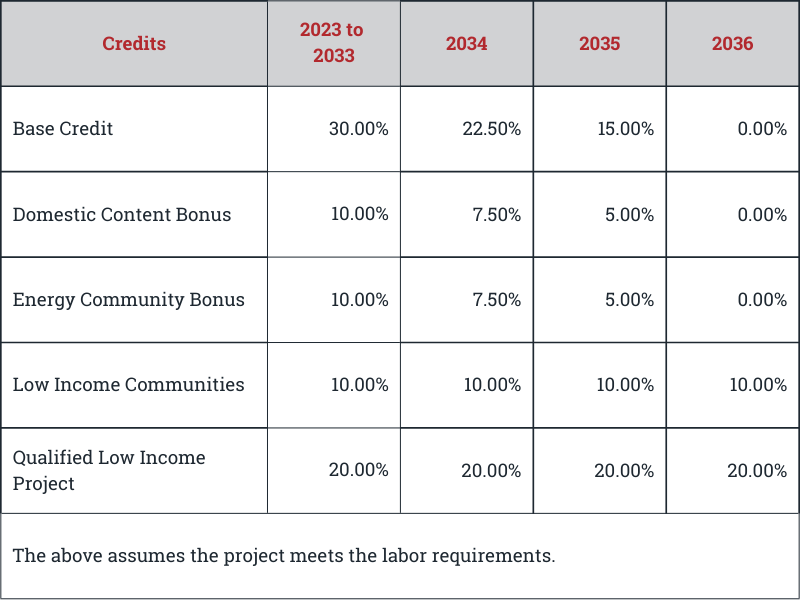
In addition to the 30% ITC, starting in 2023 businesses can also utilize stackable “bonus” ITC adders that can increase the ITC up to 50%. The following are the adders:
- Domestic content bonus – You can earn an additional 10% if the project if the steel and iron used is 100% sourced from the U.S. and manufactured components must be at least 40% U.S. sourced. The treasury secretary can provide exceptions to these rules if the cost increases 25% or if not readily available in the U.S.
- · Low-income community bonus – You can earn an additional 10% if the project is located in a low-income community. Low-income communities are those with at least 20% poverty rate or whose residents earn less than 80% of the statewide median income.
- Energy community bonus – You can earn an additional 10% if the project is located in or on a brownfield site or an area with significant employment related to fossil fuels or a coal-related census tract.
The new law provides special depreciation benefits for projects including the following:
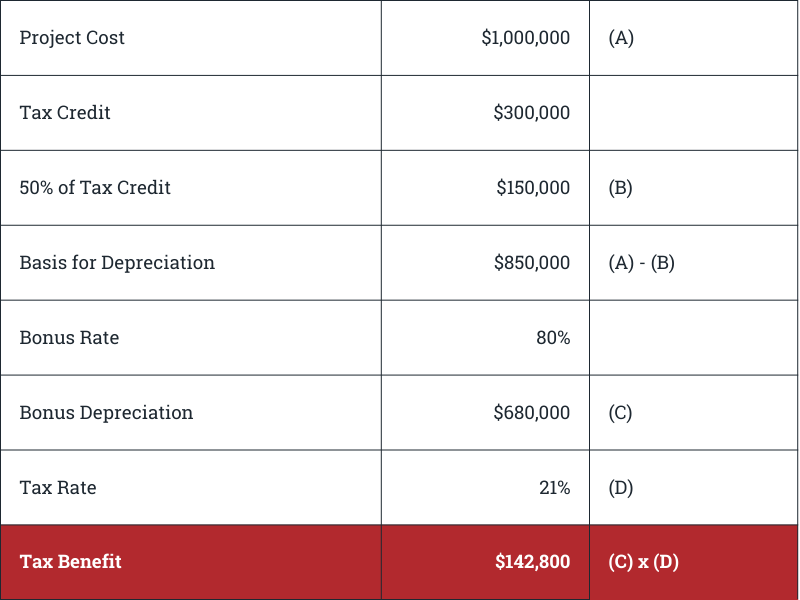
- Bonus depreciation – In 2023, the bonus depreciation is 80% which decreases by 20% each subsequent year. Ordinarily, you reduce the basis of the depreciable property by the full amount of the any credit. But the ITC reduces the property’s by only half of the credit amount, increasing your deduction.
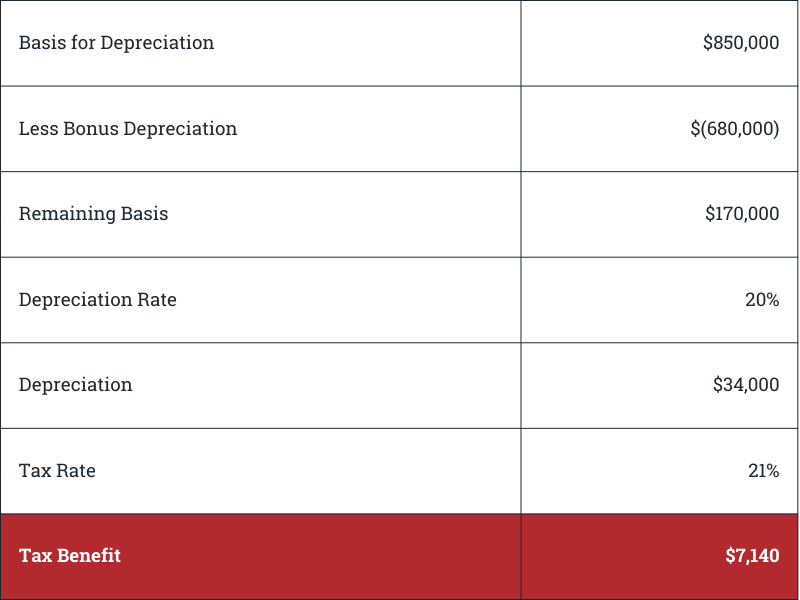
- Five-year depreciation – Energy property gets a five-year depreciation under MACRS which is generous because solar panels usually last 25 to 30 years.
Examples of Applying the Tax Credit
To illustrate how each incentive and the depreciation would be calculated based on a business that commenced construction of an energy project with a cost of $1,000,000 and put in service in 2023:
ITC Calculation:
Step 1: The following represents the tax credit calculation:

Step 2: Once the credit has been calculated, the next step is to calculate the bonus depreciation. Because the business is claiming the ITC, the business gets favorable treatment in the basis. The following represents the bonus depreciation calculation:
Step 3: Once the bonus depreciation has been calculated, the next step is to calculate the depreciation based on 5-year MACRS. The following represents the depreciation calculation:
The following is a recap of the tax benefits for the 1st year of the completed project:
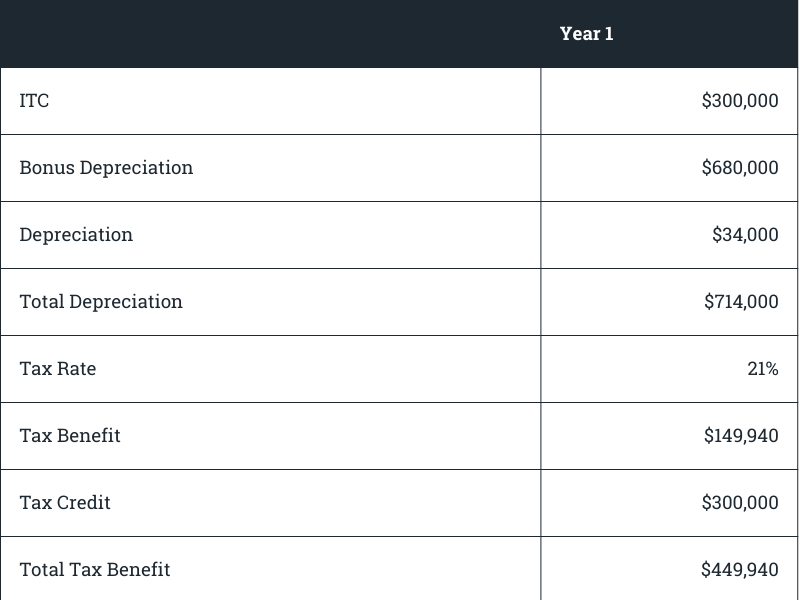
Based on the example, the business had tax benefits in Year 1 of $449,940 on a $1,000,000 project.
The ITC is non-refundable which means it can only reduce your tax liability to 0 and not below. The good news is the ITC is transferable. This allows the business to transfer all or part of your ITC to another taxpayer for cash. The buyer of your ITC need not be a business or be involved in the renewable energy industry but can’t be related to you.
The following is a recap of the ITC:
Labor Requirements for the Energy Tax Benefits
To qualify for the full ITC or PTC, projects which commenced construction prior to January 31, 2023, must satisfy the Treasury Department’s labor requirements: all wages for construction, alteration, and repair—for the first five years of the project for the ITC and the first ten years of the project for the PTC—must be paid at the prevailing rates of that location. In addition, a certain percentage of the total construction labor hours for a project must be performed by an apprentice. The percentage increases over time, starting at 10% for projects beginning construction in 2022, 12.5% for projects beginning construction in 2023, and 15% for projects beginning construction after 2023.
Projects can correct the prevailing wage requirements, if they were originally not satisfied, by paying the affected employees the difference in wages plus interest and paying a $5,000 fee to the Labor Department for each impacted individual. The apprenticeship requirements also can be satisfied if a good faith effort was made to comply or if a penalty is paid to the Treasury in the amount of $50/hour of non-compliance. Both penalties increase if the requirements are intentionally disregarded.
Retirement Planning
Comparing Roth IRAs and Designated Roth Accounts to Traditional Deductible IRAs
Many individuals must decide whether it is better to contribute to a Roth IRA or a traditional deductible IRA. Generally, the taxpayers faced with this decision (i.e., those eligible to make contributions to either a Roth IRA or a deductible IRA) are the following:
a) Married taxpayers (or a married spouse) who are either (1) not covered by an employer-sponsored retirement plan and whose modified AGI is less than $214,000 or (2) covered by an employer-sponsored plan and whose modified AGI is less than $129,000 for 2022; or (1) not covered by an employer-sponsored retirement plan and whose modified AGI is less than $228,000 or (2) covered by an employer-sponsored plan and whose modified AGI is less than $136,000 for 2023.
b) Single or head-of-household taxpayers who are either (1) not covered by an employer-sponsored retirement plan and whose modified AGI is less than $144,000 or (2) covered by an employer-sponsored plan and whose modified AGI is less than $78,000 for 2022; or (1) not covered by an employer-sponsored retirement plan and whose modified AGI is less than $153,000 or (2) covered by an employer-sponsored plan and whose modified AGI is less than $83,000 for 2023.
Modified AGI and IRA Contributions
When available, contributions to designated Roth accounts (DRAs) or Roth 401(k) accounts are not limited by an individual's modified AGI or lower IRA limits. High-income individuals can contribute to a DRA even when their income exceeds the modified AGI limit for a Roth IRA. The decision depends on the client's unique tax and financial situation. One should make this decision only after considering such factors as the person's age, current income tax situation, net worth, and expected post-retirement tax situation. As with most tax planning alternatives, the planner should calculate the numbers for all other options before deciding on a particular tax planning strategy. Many commercial software calculators are available for comparing Roth IRAs to traditional deductible IRAs. Some may consider different factors than others, so planners must consider the variables applicable to their client's situation.
Suppose a taxpayer can contribute to a 401(k) plan where the employer matches employee contributions. In that case, it generally pays for the taxpayer to make 401(k) contributions to the extent needed to get a full employer match before putting money into an IRA. DRAs provide another option for saving with many of the same advantages as a Roth IRA and simultaneously obtaining the employer match. The designated Roth option is available only if an employer sponsoring a 401(k) plan chooses to make it available.
Generally, helping a client decide will highlight the critical differences between Roth IRAs, DRAs, and deductible IRAs. In this regard, Roth IRAs and traditional IRAs are mirror images. Contributions to a traditional IRA are deductible, but the funds (contributions and earnings) are taxable when withdrawn. Roth IRA contributions are nondeductible, but a person can withdraw qualifying distributions of contributions and earnings tax-free. Thus, the tax benefits of deductible IRAs are "frontloaded," while the tax benefits of Roth IRAs are "backloaded." The tax benefits of the designated Roth accounts are generally the same as those of Roth IRAs, except that the mandatory distribution rules apply, and the contribution limits are increased significantly for DRAs. See Appendix 5A for a chart summarizing the key differences between traditional IRAs, Roth IRAs, and DRAs.
Advantages of a Roth IRA or a Designated Roth Account
The advantages of a Roth IRA are: making tax-free withdrawals (if the requirements are satisfied) and no mandatory distribution rules at age 73 (or 72 if the recipient's birthday was before 2023; or 75 if the recipient's birthday was before 2033). Planning for Distributions discusses IRA distribution rules in greater detail.
The same advantages apply to designated Roth accounts (DRAs), except that they are subject to the same mandatory distribution rules as the 401(k) deferral accounts as long as the account is part of a 401(k) plan. See paragraph 501.12 for one way to avoid required minimum distributions (RMDs).
Roth IRA distributions are taxable only in limited circumstances. Qualified distributions are entirely free of tax. Even if the taxpayer receives a nonqualified distribution from a Roth IRA, only the earnings are taxed. Furthermore, earnings are distributed after contributions. (Appendix 6C summarizes the ordering rules for Roth IRA distributions.) Therefore, taxpayers can withdraw an amount up to the cumulative contributions at any time, tax-free and penalty-free. However, earnings included in nonqualified distributions are subject to the 10% early distribution penalty unless the individual has met the five-year and age 591 ⁄2 requirements (see section 603) or the withdrawal qualifies for an exception to the 10% penalty (see section 606).
Unlike traditional IRAs, Roth IRAs are not subject to the minimum distribution rules during the taxpayer's lifetime [IRC Sec. 408A(c)(5)]. (See section 607.) Taxpayers can time their lifetime distributions as they see fit (e.g., to meet unplanned cash flow needs). Thus, taxpayers who do not expect to use IRA funds to pay their living expenses will presumably find that a Roth IRA is a superior wealth maximization vehicle to a traditional IRA because of continued tax-free growth until the account owner's death. The minimum distribution requirement is not subject to the 3.8% NIIT, but including taxable RMDs can increase the owner's exposure to the 3.8% NIIT (see paragraph 602.3).
The elimination of the RMD, coupled with an ability to spread post-death distributions over the life expectancy of an eligible designated beneficiary, offers flexibility and unique planning opportunities. 501.11Note: The 2019 SECURE Act changes the distribution period to a non-spouse designated beneficiary from a lifetime distribution period to a 10-year maximum distribution period (2019 SECURE Act Section 401). Under this change, the IRA must distribute all amounts held by the end of the 10th calendar year following the year of the IRA owner's death. Exceptions to the 10-year maximum distribution period include distributions to (a) disabled or chronically ill beneficiaries, (b) a child of the participant or IRA owner who has not reached the age of majority, and (c) a beneficiary who is no more than ten years younger than the deceased participant or IRA owner. This change is effective for distributions concerning IRA owners who die after December 31, 2019.
DRAs are subject to the mandatory distribution rules at the applicable age listed in Exhibit 607-1. Therefore, the ability to roll the funds to a Roth IRA provides an opportunity to avoid taking mandatory distributions. However, mandatory distributions from the Roth IRA are required after the owner's death. Individuals should consider opening a Roth IRA before or soon after contributing to a DRA to be prepared for a future rollover to avoid the minimum distribution rules or to be able to make qualified distributions from the Roth IRA at the earliest date. The five-tax-year period for qualified distributions from a DRA and a Roth IRA is determined independently.
Factors Favoring a Roth IRA or Designated Roth Account
Consider the following general principles when evaluating the benefits of a Roth IRA or a designated Roth account (DRA) compared to a traditional deductible IRA.
a) Generally, the longer the period the funds will be invested, the more beneficial the deferral and tax-free distribution advantages of the Roth IRA. In the long term, taxpayers will accumulate more after-tax income under a Roth IRA than a traditional IRA. The shorter the fund's investment period, the more beneficial the immediate tax savings advantage of the deductible IRA. Roth IRAs are desirable for young taxpayers who can take advantage of a long tax-free compounding period.
b) A taxpayer who expects to be in a higher tax bracket at retirement than today would favor a Roth IRA with its tax-free withdrawals at retirement, while an individual who intends to be in a lower tax bracket at retirement would prefer a traditional IRA with its current deduction at today's higher tax rate.
c) A Roth IRA generally is preferable for taxpayers currently in a low tax bracket who anticipate remaining so. They will realize little or no immediate tax savings from contributing to a deductible IRA.
d) Because Roth IRA withdrawals come first from contributions (not taxed and not subject to the 10% early distribution penalty when withdrawn), taxpayers can withdraw contributions from a Roth IRA tax-free and penalty-free at any time, regardless of fund usage. Withdrawal is true even if the five-year waiting period has not expired and the taxpayer is not yet age 59½. (See section 603.) Thus, Roth IRAs can be helpful for taxpayers who may need their original contributions (for whatever purpose) before retirement.
e) If a DRA is available, it should be utilized to allow the taxpayer to receive any available match from the employer.
Example: Using a Roth IRA to Fund Education Expenses
Bruce, age 55, opened a Roth IRA in 2015 and will contribute the maximum amount each year. His son, Brandon, will begin college in 2027. Bruce intends to withdraw funds from the Roth IRA in 2026 to help fund Brandon's education. Because Bruce will be over 59½ and opened the Roth IRA at least five years before that time, the withdrawal of contributions and the related earnings will be tax-free.
Effect of Marginal Tax Rate on Retirement
If the taxpayer's marginal tax rate is higher in retirement than today, the Roth IRA is more likely to be a better choice than a deductible IRA. Even a slight increase in the tax rates between the money contribution time and withdrawal is enough to tilt the scales in favor of the Roth IRA.
Knowing the future tax rate an individual will be subject to retirement makes it easier to answer whether they should consider making Roth IRA contributions or a Roth conversion. If the individual's marginal rate were higher at retirement than now, the individual should consider saving in a Roth account. Increases in future tax rates can come from at least two sources. A Taxpayer can have more income in the future versus the current tax year; thus, a higher marginal tax rate or tax rates could be higher. State income taxes could also be a factor if the taxpayer anticipates moving from a low-tax state to a higher one.
Conversely, suppose a significant drop in tax rates is expected (either because of the taxpayer's changing circumstances or because of an overall rate decrease). In that case, the advantages of a Roth IRA are reduced or eliminated, and the deductible IRA may be a better choice. Example Impact of marginal tax rates.
Tom Smith, age 60, has $2,000 of income to invest and is considering either a Roth IRA or a deductible IRA. Tom is in a combined 28% federal and state tax bracket. If he contributes $2,000 to a Roth IRA, $560 of tax (28% of $2,000) will be due on the income. Tom's tax planner put together different scenarios to determine whether a Roth IRA or deductible IRA is more advantageous. The sole difference in the following scenarios is Tom's marginal tax rate at the time of the contribution versus when funds are taken out of the IRA. (Because Tom is at least 59½ before taking an IRA distribution, the 10% early distribution penalty tax does not apply.)
Scenario 1: Marginal Rate Stays the Same.
In the first scenario, Tom's marginal rate stays the same. Tom would only have $1,440 to invest using a Roth IRA after paying $560 of income tax on the $2,000 earnings. After five years, this $1,440 grows to $2,319, assuming a 10% annual return. At that point, Tom could withdraw the funds without additional tax liability. The total of $2,000 can be invested in a traditional IRA because no income tax is due on the $2,000 of earnings. Again assuming a 10% annual return, the $2,000 contribution will grow to $3,221 in five years. However, if Tom withdraws the entire balance at that point, a tax of $902 ($3,221 × 28%) is due, leaving an after-tax balance of $2,319. The balance is the same amount Tom would have with a Roth IRA. Thus, when the tax brackets remain the same, and the upfront tax costs reduce the contribution to the Roth IRA, it makes no difference which type of IRA a person chooses. However, compare this to the results shown in the Exhibit, where the upfront cost of the income tax due does not reduce a $2,000 annual contribution to a Roth IRA.
Scenario 2: Marginal Rate Increases.
What if Tom's marginal rate increases? Taxpayers assume automatically that their tax rate will drop when they retire. It may even increase (because their income does not significantly decrease when they retire, or because Congress raises the tax rates or some combination of both). This scenario assumes a 31% (instead of 28%) marginal tax rate of withdrawn funds and no changes for the Roth IRA - it still increases to $2,448 after five years. When using a traditional IRA, the total $2,000 contribution will grow to $3,221 in five years, as before, assuming a 10% growth rate. However, if Tom withdraws the entire balance at that point, a tax of $999 ($3,221 × 31%) is due, leaving an after-tax balance of $2,222. Therefore, the Roth IRA generates $97 ($2,319 − $2,222) of additional after-tax income. Under this scenario, the Roth IRA is the better choice; as illustrated, even a slight increase in the tax rates between the time the investment and withdrawal of the money make enough difference to tip the scales in favor of the Roth IRA.
Scenario 3: Marginal Rate Decreases.
What if Tom's marginal tax rate drops from 28% (when the contribution is made) to 18% (five years later when the accumulated funds are withdrawn)? Using a Roth IRA, the results would be the same as in the previous scenarios. Tom would only have $1,440 to invest after paying $560 of income tax on the $2,000 of earnings. After five years, this $1,440 grows to $2,319, assuming a 10% annual return. At that point, Tom could withdraw the funds without additional tax liability.
When using a traditional IRA, $2,000 can be invested because no income tax is due on the $2,000 of earnings. Again assuming a 10% annual return, the $2,000 contribution will grow to $3,221 in five years. However, if Tom withdraws the entire balance at that point, a tax of $580 ($3,221 × 18%) is due, leaving an after-tax balance of $2,641. Therefore, the deductible IRA generates $322 ($2,641 − $2,319) of additional after-tax income. This $322 difference represents an almost 14% better return over the five years for the deductible IRA.
Note: The previous scenarios are based on five years, but the results would be more dramatic as the period gets longer and additional IRA contributions are made. Also, any positive impact on AGI-sensitive deductions resulting from the deductible IRA and the negative effect of distributions from a deductible IRA have been ignored.
Taxpayers in the lowest and the highest tax brackets may find the Roth IRA more beneficial for different reasons. Taxpayers in the lowest bracket may find that traditional IRA distributions will cause more of their social security benefits to become taxable. Taxpayers in the highest tax bracket may find that conventional IRA distributions cause them to exceed the AGI threshold that caused them to become subject to the 3.8% net investment income tax ($250,000 for married filing joint, $125,000 for married filing separately, and $200,000 for all other filing statuses).
Using these assumptions, the Roth IRA generates the most wealth even before considering the effect of the favorable distribution rules (i.e., no minimum required distribution until after the owner's death and faster basis recovery rules for any taxable distributions) and estate tax rules. Although a more significant amount can be invested each year using a traditional IRA (since the tax saving is available for investing), paying current tax on the "outside account" reduces the effect of investing additional funds.
Designated Roth Accounts Provide for Higher Contributions
Roth IRA and traditional IRA contributions for 2022 are limited to $6,000 ($7,000 if age 50 or over by December 31 of the applicable tax year), and for 2023 are limited to $6,500 ($7,500 if age 50 or over by December 31 of the applicable tax year). Designated Roth accounts (DRAs) are subject to the same limits that apply to 401(k) elective deferrals ($20,500 for 2022; $27,000 if age 50 or over by December 31, 2022; $22,500 for 2023; $30,000 if age 50 or over by December 31, 2023). The nondiscrimination rules may further limit the limit for highly compensated employees.

Retirement Planning
Deciding When to Start Receiving Social Security Benefits
A client approaching retirement age must decide whether to begin taking reduced benefits early or wait until full retirement age (FRA) (or later). For many clients, the present value of the social security retirement benefits they would receive is similar under either option, depending on their life expectancy and tax bracket. Therefore, in many cases, this decision will depend on factors other than trying to receive the most significant lifetime benefit from social security. The Consumer Financial Protection Bureau offers a social security claiming tool to help workers decide the best age to receive retirement benefits.
Some clients will delay retirement and continue to work because of personal preferences. Others will want to retire early and need to start receiving benefits as soon as possible.
Some clients choose to take early social security benefits out of necessity. They are unemployed or underemployed, or they have an immediate financial need. Unfortunately, in many cases, taking the early, reduced benefit ensures their continued financial predicament. Studies suggest that those who take early benefits out of necessity often find themselves in even more desperate straits in later years as they continue struggling with their permanently reduced benefit. Early retirement may be a shortsighted but necessary solution for these individuals.
Those in a better financial situation often have the luxury to wait and allow their benefits to increase, thus ensuring a more comfortable retirement. These are the clients who can best benefit from a planner's help to make an informed decision.
The Social Security Administration provides numerous calculators. These tools help clients find the age at which total benefits received are equal at different starting dates. While clients may have the option of receiving social security benefits as early as age 62, the eligibility age for Medicare remains at 65. So, although they may be able to replace a sufficient amount of their earned income with social security benefits at age 62, they may not adequately replace their employer-provided health insurance for another three years.
Some clients may choose early benefits based on their concerns about the potential insolvency of the Social Security Trust Fund. This insolvency may be a legitimate concern, but complete abandonment of the retirement program is unlikely. It is more likely that the government will alter the tax rate, the wage base, and the benefits of future retirees. Still, planners must recognize this fear among certain clients.
The availability of qualified longevity annuity contracts (QLACs), which provide income guarantees later in life, can alter social security claiming strategies. Instead of delaying receipt of social security benefits to claim a higher amount, clients can take benefits at the average retirement age and then rely on a QLAC to provide increased income later in retirement.
Factors to Consider in Taking Reduced Benefits at Age 62
Even if the retiree has sufficient funds to live on without considering social security, many planners advise clients to begin receiving benefits as soon as possible. In 2023, the benefits at age 62 are reduced by 30% of what they would be at age 67 (i.e., the FRA). Still, the client will receive more social security checks if benefits are drawn early. In addition, drawing early social security benefits may allow the client to leave tax-deferred retirement accounts untouched and grow for extended periods.
Another reason clients may want to receive benefits early is if they have dependents under 18. Such dependents may be eligible for benefits if the clients also receive social security benefits.
Break-Even Point
If the worker waits until the FRA to draw benefits and the primary insurance amount, or PIA (which is a function of his earnings history) remains the same, it will take around 12 years to reach the break-even point to make up for the years of payments that the client did not receive.

The analysis above compares only the social security benefits. It does not consider the forgone investment income Curt could have earned from age 62 through age 67 on the early benefits or the compounded future value of that sum.
The break-even point may vary. For example, there may be one break-even point when the client decides whether to claim at age 62 or 66 (or older applicable FRA). There will be a different break-even point when the client decides between claiming at age 62 or 70. And there will be another break-even point when the client decides whether to claim at age 66 (or older FRA) or 70. Future COLA adjustments also impact the break-even point, which are not reflected in the SSA's benefit estimates. Therefore, the break-even point between claiming early versus delayed could be earlier.
The preceding example illustrates that the worker's life expectancy and the spouse's life expectancy (if applicable) should be considered when determining the starting date for social security benefits. Suppose the client in the preceding example does not expect to live until age 79. In that case, Curt will receive more benefits by taking the reduced monthly payment.
If the present value of future social security benefits is considered, it would typically be more favorable to start the benefits as soon as possible (if the money was going to be invested). However, suppose the client is simply using early social security benefits to replace a similar amount of earned income. In that case, the short-term financial position will not be improved, and the long-term outlook could suffer.
Another factor to consider in taking retirement benefits early is the increased tax cost for some workers. With a smaller social security retirement benefit, the worker may need to draw on other resources to meet expenses. If the additional income exceeds the provisional income thresholds, 50% or even 85% of the worker's social security benefits will be taxable. In addition, the worker who has earned income that exceeds certain thresholds will forfeit some social security retirement benefits.
Factors to Consider in Waiting Until Full Retirement Age
Those who reach age 62 and need income may not have the option of waiting until their FRA before they begin receiving benefits. And those with a shorter life expectancy might be wise to start receiving benefits as soon as they can because they may not receive them for very long.
However, other retirees might carefully consider the long-lasting advantages of waiting until their FRA. Factors to consider include:
- Life expectancy.
- Shortening the retirement period.
- The earnings test.
- Replacing earlier lower-wage years with later higher-wage years.
- The compounding of inflation adjustments on a higher base.
- Effect on the spouse.
- Other assets available.
- Having a higher-earning spouse delay until 70 and having a lower-earning spouse claim early.
- Working part-time.
- Drawing down on qualified plans prior to RMD issues at a later date or when in a relatively low tax bracket in a given year.
Life Expectancy
The client's life expectancy may be the most significant factor in deciding whether to receive social security benefits early. While life expectancy tables and averages are available, a 62-year-old client should have a good handle on his or her own life expectancy. The current health and longevity of parents should be clearly established by that age. In general, 80 years might be a good cutoff point. If the client reasonably expects to reach that age, waiting until the FRA may be a wise choice. Northwestern Mutual Life Insurance Co. has an online lifespan calculator that considers such factors as weight, exercise, diet, family history, etc. Keep in mind that if the client is married, the life expectancy of both spouses should be considered. Also, as the client ages, his or her life expectancy increases.
A 60-year-old client might expect to live to age 82, for example. But a client who has already reached age 66 might expect to live into his 90s.
Shortening the Retirement Period. A significant factor in retirement planning projections is the length of the retirement period. This is determined by subtracting the age at retirement from the life expectancy. For example, if a client wants to retire at age 62 and has a life expectancy of 85, there is a 23-year retirement period to fund. By working past age 62, the client is shortening the retirement period and decreasing the resources needed to fund the retirement regardless of longevity.
The Earnings Test
Clients who are considering receiving social security retirement benefits before their FRA but who also intend to keep working must consider the earnings test. For 2023, the exempt amount is $21,240 (for years before reaching their FRA). This means that social security benefits are reduced by $1 for every $2 in earnings above that exempt amount. Clients already facing a reduced benefit amount because of their early retirement would have their benefits reduced even further by exceeding the earned income exempt amount.
Replacing Lower-Wage Years
An individual's social security benefits are based on his primary insurance amount. The PIA is calculated from the individual's highest 35 years of indexed earnings. If a client can replace lower-wage years early in his or her career with higher-wage years after age 62, the PIA can be increased. This can lead to a greater retirement benefit when the individual retires. A higher PIA will also increase disability and survivor's benefits.
Inflation Adjustments
Social security benefits receive an annual inflation adjustment. By taking early benefits, the individual's starting base for annual adjustments is smaller. For example, if an individual's PIA was $1,000, but he or she retired early and received only $750 each year, he or she would miss out on the compounded inflation adjustment of that $250 in lost benefits. In other words, the gap between the early retirement benefit and the amount he or she would have received by waiting will get bigger and bigger.
The Effect on the Spouse
The individual's decision to start receiving social security benefits before reaching the FRA may also affect a spouse's benefits. Unless the spouse has a personal earnings record and is fully insured, he or she will be dependent on the working spouse's PIA for retirement benefits. A spouse who waits until FRA is eligible to receive 50% of the working spouse's retirement benefit. However, a worker who retires early may have a lower PIA than by waiting until the FRA. Therefore, the spouse's benefit would be based on that lower PIA.
Factors to Consider in Beginning Benefits after Reaching the Full Retirement Age

As shown the analysis above, an individual who works past the FRA receives larger benefits because of the delayed retirement credit. A worker born in 1943 or later receives a credit of 8% per year for each year the worker delays receiving benefits after reaching the FRA until age 70.
If the worker can wait, the delayed retirement credit can have a significant impact. In addition to the higher retirement benefit, the worker will receive, he or she will also shorten his or her retirement period and increase the spouse's survivor's benefit. However, higher earnings after reaching FRA will not increase the worker's PIA by replacing lower-wage years.
Categories
- All
- Auditing(2)
- Business Planning(10)
- CFO Services/Accounting(4)
- City & County Budgeting(1)
- Estate Planning(4)
- Family Planning(1)
- Fiscal Sustainability(7)
- Healthcare(2)
- IRS Representation(2)
- Mergers & Acquisition(1)
- Retirement Planning(14)
- Tax Planning & Consulting(19)
- Utility Rate Study(1)